



Lion’s Mane Dosage: How Much Should You Take?
Quick Takeaways
- In all honesty, we don’t have a universal, one-size-fits-all answer for lion’s mane dosage.
- The right amount depends on the type of product, the concentration of the extract, your personal tolerance, and the reason you want to use it.
- For example, a 100 mg concentrated extract is not necessarily weaker than a much larger amount of ordinary mushroom powder.
- A reasonable approach is to follow the directions on the product label, start with the lowest recommended serving, and pay attention to how your body responds.
- We know all of this can be overwhelming, so the takeaway message should be this: Do Not Treat Every Milligram the Same.
Lion’s mane is one of the most popular functional mushrooms, especially for people who want to boost their cognition without another energy drink.
Scientifically known as Hericium erinaceus, Lion’s mane was studied extensively in animal subjects and some humans and was proven to provide a myriad of health benefits. Today, one of the biggest questions that leaves users confused is how much lion’s mane should you take?
In all honesty, we don’t have a universal, one-size-fits-all answer for lion’s mane dosage. The right amount depends on the type of product, the concentration of the extract, your personal tolerance, and the reason you want to use it.
For example, a 100 mg concentrated extract is not necessarily weaker than a much larger amount of ordinary mushroom powder. For this reason, the smartest move may not be to choose the biggest number on the label.
If you want a deep dive into the research around this mushroom, check out our guide to lion’s mane mushroom benefits.
What Is the Recommended Lion’s Mane Dosage?
As we just mentioned, there isn’t a standard dose for Lion’s mane supplements, especially since the Food and Drug Administration (FDA) does not certify the use of dietary supplements for disease treatment.
In clinical studies, researchers have used different products, doses, and timeframes. Some clinical trials have examined the powdered form of lion’s mane, and others have used concentrated extracts. As you can see, this makes it difficult to draw direct comparisons and conclusions.
A reasonable approach is to follow the directions on the product label, start with the lowest recommended serving, and pay attention to how your body responds.
| Situation | Practical Approach | Why |
|---|---|---|
| You are new to lion’s mane | Start with the lowest serving. | A lower dose makes it easier to test your tolerance. |
| You use a concentrated extract | Check the extract ratio (e.g., 10:1 or 20:1). | Extracts cannot be compared directly with ordinary mushroom powder. |
| You use more than one supplement | Calculate the total lion’s mane amount across all products. | It’s easy to go above the recommended dose if you’re taking a focus gummy, coffee blend, and capsule. |
| You develop stomach discomfort | Reduce the dose, or you can take the product with food. | Mild digestive symptoms are possible. |
| You take prescription medication | Speak with your physician first. | Supplements can affect health conditions or interact with medication. |
How Much Lion’s Mane Have Researchers Used?
Human studies can be a useful starting point to determine the ideal dosage for you. However, you should take this as a suggestion and not a definitive guide.
What we mean is that you can start with the following dosages, but we recommend adjusting them based on the type of product you are taking, reason for taking the product, and your personal tolerance.
| Study | Lion’s Mane Dose | Duration | What Researchers Found |
|---|---|---|---|
| Mori et al., 2009 | 3 grams of powdered lion’s mane per day. | 16 weeks. | Adults with mild cognitive impairment experienced improved cognition. |
| Docherty et al., 2023 | 1.8 grams per day. | 28 days. | Faster performance on one cognitive task after a single dose. The users also reported less stress and anxiety. |
| Surendran et al., 2025 | A single 3-gram dose of a standardized 10:1 extract. | One dose. | The extract only produced a minor improvement in cognition. |
The table explains why lion’s mane dosage is not a simple “take X milligrams” question. Different studies use different preparations and focus on different goals. For example, some studies focused on long-term effects, and others examined what would happen after a single dose.
Lion’s Mane Powder vs. Extract
Lion’s mane comes in several forms:
- Fresh mushroom.
- Dried mushroom powder.
- Capsules.
- Liquid extracts.
- Coffee blends.
- Functional mushroom gummies.
Remember that the number on the label only makes sense when you know what form you are taking.
For instance, a powder usually contains dried mushroom material. An extract is always more concentrated, as certain compounds are pulled from the mushroom during processing. A label with a 20:1 extract ratio means the product uses a concentrated form.
Additionally, the part of the mushroom may also be important. Some products use the fruiting body, which is the visible mushroom, and others use mycelium, which is the root-like network that grows beneath the surface. In some instances, you may find formulas that combine both forms.
We know all of this can be overwhelming, so the takeaway message should be this: Do Not Treat Every Milligram the Same.
How Much Lion’s Mane Is in Sunday Scaries Mushroom Gummies?
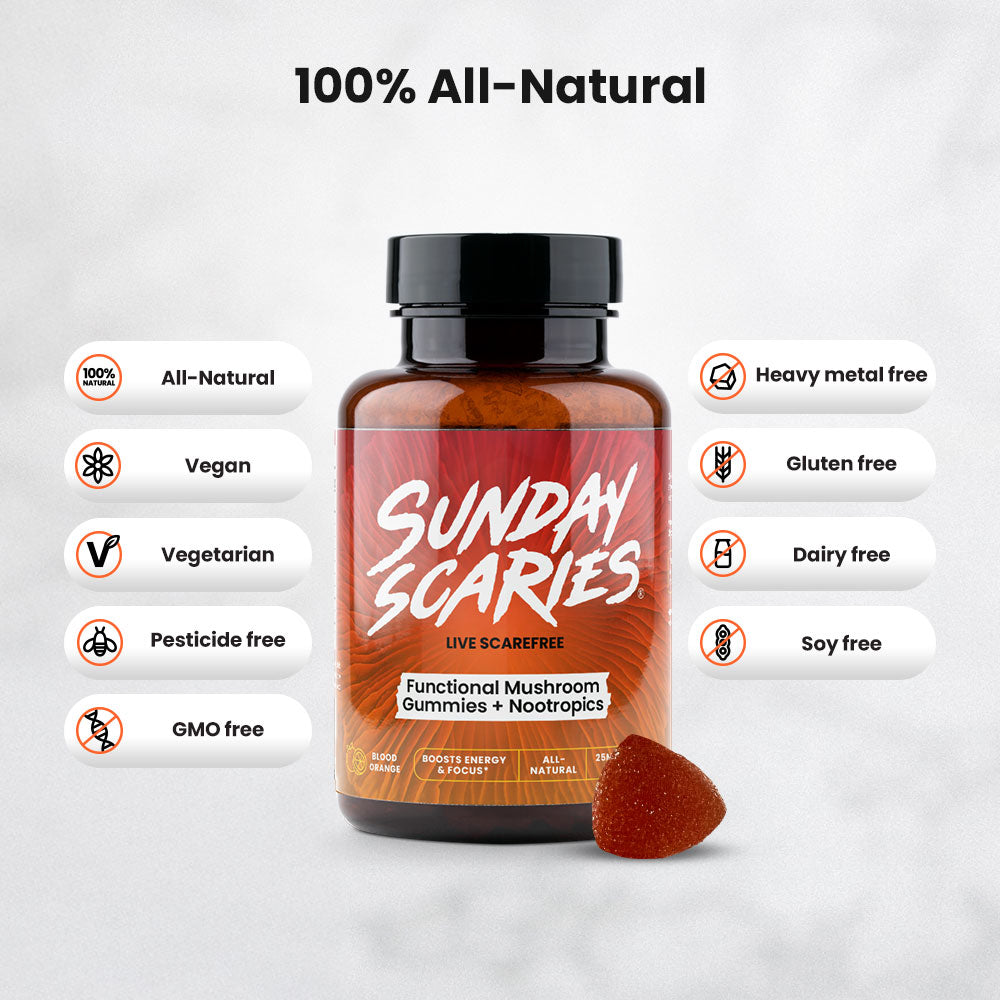
Pre-Dosed Focus Formula
100 mg Lion’s Mane Extract 20:1 Concentration Chaga Powder Ginkgo Biloba Natural CaffeineSunday Scaries Mushroom Gummies for Focus contain 100 mg of organic lion’s mane extract with a 20:1 concentration per gummy. The gummy also includes chaga powder, ginkgo biloba extract, and natural caffeine.
This makes the gummies different from lion’s mane powder. The goal of the product is to boost focus instead of replicating every clinical trial protocol.
Shop Mushroom Gummies for FocusIf you don’t want to learn the chemistry of mushroom dosage, you can check out Sunday Scaries functional mushroom gummies collection for a simpler pre-dosed option.
Should You Take Lion’s Mane in the Morning or at Night?
Many people prefer the morning or early afternoon because they use lion’s mane as part of a focus routine. What’s important here is to have a consistent schedule to make it easier to track whether the supplement is making a difference over time.
You also need to pay attention to the other ingredients in the product. For example, many Lion’s mane supplements contain caffeine and other energy-boosting ingredients. In this case, it’s best to take them as early as possible since they may interfere with sleep hygiene if they’re taken late.
If you notice some digestive symptoms after taking Lion’s mane, try to take the supplement in the middle of a meal.
How Long Does Lion’s Mane Take to Work?
Lion’s mane usually shows subtle effects after a few days of taking it, especially when the product also contains caffeine. However, the full effects of lion’s mane may take a few weeks to kick in.
The Memorial Sloan Kettering Cancer Center notes that Lion’s mane supports memory, mood, and stress. It’s indispensable to have realistic expectations, so we recommend that you give the routine time before you decide whether this product is worth it or not.
Related: What mushroom gummies are.
Can You Take Too Much Lion’s Mane?
Taking too much of Lion’s mane doesn’t mean in any way that the results are better. In fact, the chances of side effects become more likely.
The NIH LiverTox review denies any connection between lion’s mane and liver injury. Of course, like any dietary supplement, you might experience mild digestive symptoms such as abdominal discomfort, nausea, and diarrhea.
If you develop a rash, difficulty breathing, facial swelling, and other signs of allergic reactions, stop taking the supplement immediately. This could be a sign that you are allergic to Lion’s mane or one of the ingredients in the supplement.
Speak with your doctor before you take lion’s mane if you:
- Have a mushroom allergy.
- Are pregnant or breastfeeding.
- Take prescription medication.
- Manage a chronic health condition.
- Plan to combine several supplements.
FAQs About Lion’s Mane Dosage
1. How many milligrams of lion’s mane should a beginner take?
Start with the lowest serving listed on the product label and assess your tolerance before you make any changes.
2. Can you take lion’s mane every day?
Several lion’s mane products are designed for daily use. Moreover, we have numerous clinical studies that examined regular use over multiple weeks.
3. Should you take lion’s mane with food?
Lion’s mane can be taken with or without food unless the label says otherwise. It’s best to take it with food if you develop any digestive issues.
4. Is 100 mg of lion’s mane enough?
Again, this depends on the form. For example, a concentrated extract cannot be compared directly with 100 mg of ordinary mushroom powder. Check the extract ratio and the full label before you judge a product based on a single number.
5. Can you take lion’s mane with coffee?
People usually drink their morning coffee and take a lion’s mane supplement. We recommend that you pay attention to your total caffeine intake, especially if you read on the label that the Lion’s mane supplement contains caffeine.
Skip the Dosage Guesswork
Try a pre-dosed focus gummy with concentrated lion’s mane extract, chaga, ginkgo biloba, and natural caffeine.
Shop Mushroom Gummies for FocusThis article is for informational purposes only and is not intended to provide medical advice, diagnosis, or treatment. There is no universally established lion’s mane dose for treating a medical condition. Follow the product label and speak with a qualified healthcare professional before using lion’s mane if you take medication, manage a health condition, are pregnant or breastfeeding, or have a mushroom allergy.