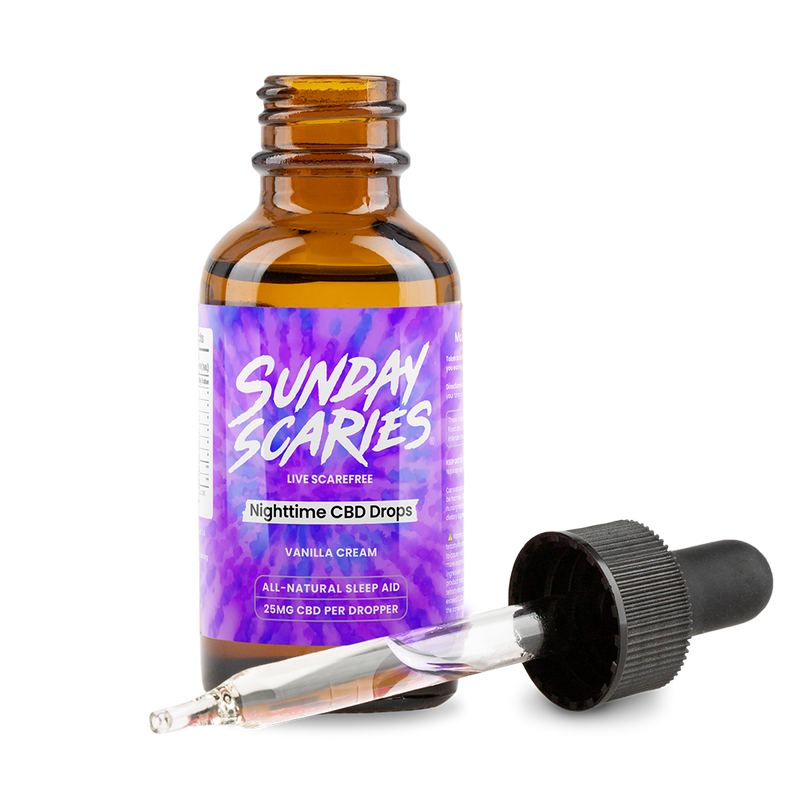



Full-spectrum CBD keeps everything the hemp plant offers, including a trace of THC, and may sleep slightly better thanks to the "entourage effect."
Broad-spectrum strips the THC out while keeping the other helpful compounds, which makes it the pick for anyone who's drug-tested or THC-sensitive. For sleep, full-spectrum often has a small edge, but broad-spectrum is no slouch.
It's 1 am. You're horizontal, eyes shut, doing everything right, and your brain has chosen this exact moment to rehearse an argument from 2014 and remind you that the mortgage exists.
You've decided CBD might help. Great instinct.
Then you hit the label wall: "full spectrum," "broad spectrum," and a price tag, with zero explanation of which one actually knocks you out.
As if the acronyms and fancy lingo weren't enough, now there's spectrums to consider. Fortunately, it's all quite simple.
The difference comes down to one tiny ingredient (THC, in trace amounts) and one big idea (the entourage effect). Get those two straight, and the choice basically makes itself. So let's settle the bedtime debate without the marketing fog.
Quick Takeaways
- Full spectrum = all hemp compounds, including trace THC (under 0.3%). Broad spectrum = the same minus the THC.
- The "entourage effect" suggests compounds work better together, which may give the full spectrum a slight sleep edge.
- That entourage effect is a popular theory, not a fully proven fact. Keep expectations honest.
- Broad spectrum is the smart pick if you're drug-tested, THC-sensitive, or just want zero THC.
- Sleep blends often add CBN or melatonin; the spectrum is only part of the story.
Full Spectrum vs Broad Spectrum: It Comes Down to One Tiny Ingredient
Full-spectrum CBD contains all the hemp plant's compounds, including a legal trace of THC (under 0.3%). Broad spectrum contains the same supporting cannabinoids and terpenes but has the THC removed. The single dividing line is whether there's a tiny bit of THC in the bottle.

That's genuinely the whole distinction. Full spectrum includes trace THC; broad spectrum keeps the other cannabinoids but strips the THC out. Both keep the broader cast of hemp compounds (minor cannabinoids, terpenes) that a pure CBD isolate would lack.
Why does a trace of THC matter so much?
Two reasons: it may contribute to the entourage effect (more on that next), and it's the thing that can show up on a drug test. Small ingredient, big implications.
The Entourage Effect: Real Science or Group-Project Myth?
The entourage effect is the idea that hemp's compounds work better as a team than any one does alone, so full spectrum (THC included) may produce a slightly stronger calming, sleep-friendly effect. It's a well-supported theory, but still a theory, not settled science.

CBD, trace THC, minor cannabinoids like CBN, and aromatic terpenes may amplify each other, so the whole is greater than the sum of its parts.
For sleep, that's appealing, because full spectrum's mix, including CBN (the "sleepy cannabinoid"), interacts with the systems that influence the sleep-wake cycle.
The honest caveat, because this is exactly where marketing overreaches: the entourage effect remains a popular idea among experts rather than a definitively proven fact.
That doesn't mean it isn't real, just that you shouldn't treat "entourage effect" as a guarantee. Plenty of people sleep beautifully on broad spectrum.
So Which One Actually Knocks You Out?
Full spectrum often gets the slight nod for sleep, because the trace THC and the full compound mix may deepen the calming effect. But "better" depends on you. If THC is a problem for any reason, broad spectrum is the better choice, and it still works well for most people.
The general lean: full spectrum is frequently considered a touch better for sleep due to the fuller entourage effect, with that bit of THC and the cannabinoid supporting cast working together.
But the gap isn't a chasm, and "better on paper" loses to "the one that fits your life" every time.
Think of it like coffee versus decaf at night. The "stronger" option isn't automatically the right one if it causes you a different problem (in this case, THC).
When Broad Spectrum Wins (Drug Tests, We're Looking at You)
Choose broad spectrum if you're subject to drug testing, are sensitive to THC even in trace amounts, are pregnant or breastfeeding (check with a doctor first), or simply want zero THC for peace of mind. You keep most of the benefits without the THC question.
Broad spectrum exists for exactly these situations:
- You're drug-tested. Even trace THC can, in rare cases, build up and trigger a positive. If your job tests, broad spectrum removes the worry.
- You're THC-sensitive. Some people react to even tiny amounts. Broad spectrum sidesteps that.
- You just don't want THC. Totally valid. Broad spectrum keeps the other compounds and drops the controversial one.
You give up a sliver of the theoretical entourage boost, but you gain certainty, and for a lot of sleepers, certainty is what actually lets them relax.
Plot Twist: The Spectrum Might Matter Less Than Your Bedroom
Often, the spectrum is not the biggest lever. Added ingredients like CBN, melatonin, or terpenes can shape your night as much as full-versus-broad does, and your sleep habits matter even more. Read the whole label, then look at your routine.

A lot of CBD sleep products lean on add-ins: CBN for sedation, melatonin for sleep timing, calming terpenes.
Those can shape your sleep (and your morning grogginess) as much as the full-versus-broad choice. If you want to avoid waking up foggy, the melatonin dose matters more than the spectrum, which we cover in CBD sleep gummies side effects.
And the real talk no gummy company wants to say out loud: the best sleep stack starts before the bottle. A few things with more evidence behind them than any spectrum debate:
- Anchor your wake-up time. Same time every day, weekends included. Your circadian rhythm runs on consistency, and a steady wake time is the single strongest lever for falling asleep at night.
- Get morning light in your eyes. Ten minutes of daylight early on helps set that rhythm and time your natural melatonin release for later.
- Cool and dark the room. A drop in core body temperature is part of how you fall asleep, so a cool (around 65 to 68 degrees), dark room does real work.
- Dim the screens late. Bright light at night tells your brain it's noon. Even an hour of wind-down helps.
CBD can help quiet the racing thoughts that keep you staring at the ceiling. These habits handle the machinery. Use both, and you're not just masking the scaries at 11 pm, you're building a night that works.
The bottom line
Full spectrum versus broad spectrum for sleep comes down to one trace ingredient and one theory. Full spectrum keeps the THC and the complete compound mix, which may give it a small entourage-driven edge for sleep.
Broad spectrum strips the THC out, making it the clear choice if you're tested, sensitive, or THC-averse, and it still works well.
Pick full spectrum to chase the maximum effect, broad spectrum for total THC peace of mind, and either way, check the CBN and melatonin on the label, because for sleep those can matter just as much.

Wind down, wake up clear
CBD Oil for Sleep
An award-winning nighttime CBD oil with the sleepy cannabinoid CBN, built to help you drift off fast without next-day grogginess.
Shop CBD Oil for Sleep Backed by our 100% money-back guarantee.Frequently Asked Questions
Is full spectrum or broad spectrum CBD better for sleep?
Full spectrum often gets a slight edge thanks to trace THC and the entourage effect, but broad spectrum works well too and is better if you want to avoid THC. The "best" depends on your needs.
Will full spectrum CBD make me fail a drug test?
It can, in rare cases. Full spectrum contains trace THC (under 0.3%) that may accumulate with regular use. If you're drug-tested, choose broad spectrum or isolate instead.
Does broad spectrum CBD work for sleep without THC?
Yes. Broad spectrum keeps the other cannabinoids and terpenes (often including CBN) and helps many people sleep, just without the trace THC and its small entourage contribution.
What's the difference between full and broad spectrum CBD?
Full spectrum has all hemp compounds, including trace THC. Broad spectrum has the same compounds as THC, but with the THC removed. That THC (and its drug-test and entourage implications) is the only real difference.
Is the entourage effect real?
It's a widely supported theory that hemp compounds work better together, but it isn't fully proven. It may give full spectrum a modest advantage, so treat it as plausible, not guaranteed.
Give your brain a reason to clock out.
Our CBD Oil for Sleep is made to help you wind down, backed by a 100% money-back guarantee.
CBD Oil for SleepThese statements have not been evaluated by the Food and Drug Administration. This product is not intended to diagnose, treat, cure, or prevent any disease.